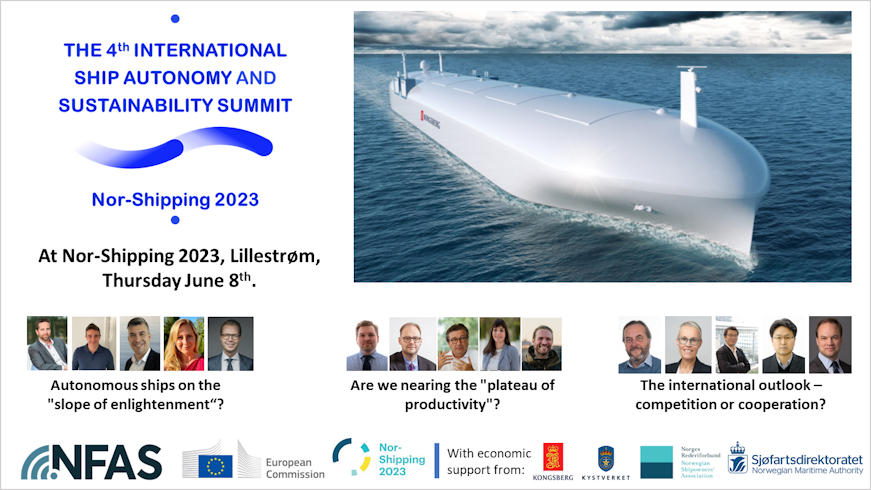
This year's edition will focus on the achievements that has already been realized and the near future practical exploitation of MASS technology. This will be in the light of the new challenges posed by increasing requirements to sustainability, resilience and adaptability for international and national shipping.
The event was co-organised by the European Commission’s Directorate General for Mobility and Transport, Nor-Shipping, and the Norwegian Forum for Autonomous Ships.
The full recording of the event is available on the links below.
Moderator: Ms. Fotini Ioannidou | Head of Unit Maritime Safety, DG MOVE – European Commission
Trond Langemyr | Chair of NFAS board
Bjørnar Selnes Skjæran | Norwegian Minister of Fisheries and Ocean Policy
Walter Goetz | Head of Cabinet for Adina Vălean, European Commissioner for Transport, European Commissioner for Transport
Since 2012 when interest in autonomous ships started to grow, there
has been relatively slow progress on real-life projects. Many claim
that we have been through both the "peak of inflated expectations"
and "trough of disillusionment" in the period. However, more
projects are materializing, and this session will discuss what the
enabling factors for autonomous ship technology are today and in the
coming five years.
- What are the main drivers for deploying autonomous ships today and in the coming years?
- How do economic, legal and insurance factors impact new projects?
- Do we see a difference in approach – from ‘cannot do unless…’ to ‘can do but…’?
Tom Eystøe | Managing Director Massterly, on new Norwegian projects from the Green Shipping Programme
Ramsay Lind | IMO representative, International Transport Workers' Federation (ITF)
Lennart Swoboda | Head of Autonomy, Bernhard Schulte
An-Magritt Tinlund Ryste | Director Next Generation Shipping Kongsberg Maritime, on AUTOSHIP demonstrations
Herman Steen | Partner Wikborg Rein Maritime Lawyers, on legal and insurance developments
While few examples of autonomous ships have been seen in real-life,
many manufacturers are already providing products for automation or
user assistance for one or more functions on the ship. Also, there is
some question about the level of autonomy the customers really are
interested in. Less autonomy will make it easier to develop technology
and to get approval for the ships.
- What are the shipowners looking for and is the industry providing what they ask for?
- How much autonomy is really useful now and in the coming years?
- Should we talk about autonomous ships or autonomous systems (e.g. including port
and onward transport)
Carl Johansson | VP Business Development Avikus, navigational safety on conventional ships
Christophe Tytgat | Secretary General Sea Europe, on European manufactures' position
Antoon van Coillie | Zulu Associates, on short sea and inland autonomous sailing
Sotiris Raptis | Acting Secretary General ECSA, on European shipowners' expectations
Mads Bentzen Billesø | DFDS on new logistics solutions
Autonomous ship technology is being developed and demonstrated in
many countries around the world and large research programs have
been established. Are we really working towards the same goals and
are there issues where more international cooperation would be a
benefit? IMO is now developing the voluntary MASS code for cargo
ships which is expected to be the basis for a mandatory MASS code
for all ship types, but this will be a goal and risk based general
requirements document that leaves the development and qualification
of new technology to the manufacturers and users, but maintaining
approval by flag State administrations.
- How far have the different nations come in development of technology?
- Are there areas where we should strive for more international cooperation?
- Could sharing of data on trials and tests be useful? Who will be given access to which data?
Ørnulf Jan Rødseth | General Manager NFAS, on Norwegian positions
Sinikka Hartonen | Secretary-General, OneSea Association, on One Sea priorities
Hideyuki Ando | Director, MTI Co., Ltd. (NYK Group), on Japan position
Byounghun Kwon | Executive Vice President / Digital Reserch Lab. KSOE, on Korea position.
Sean Pribyl | Partner, Holland & Knight LLP, on USA position
Fotini Ioannidou | Head of Unit Maritime Safety, DG MOVE – European Commission
Trond Langemyr | Chair of NFAS board